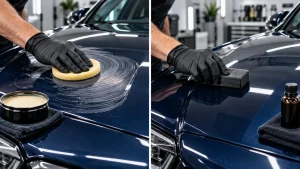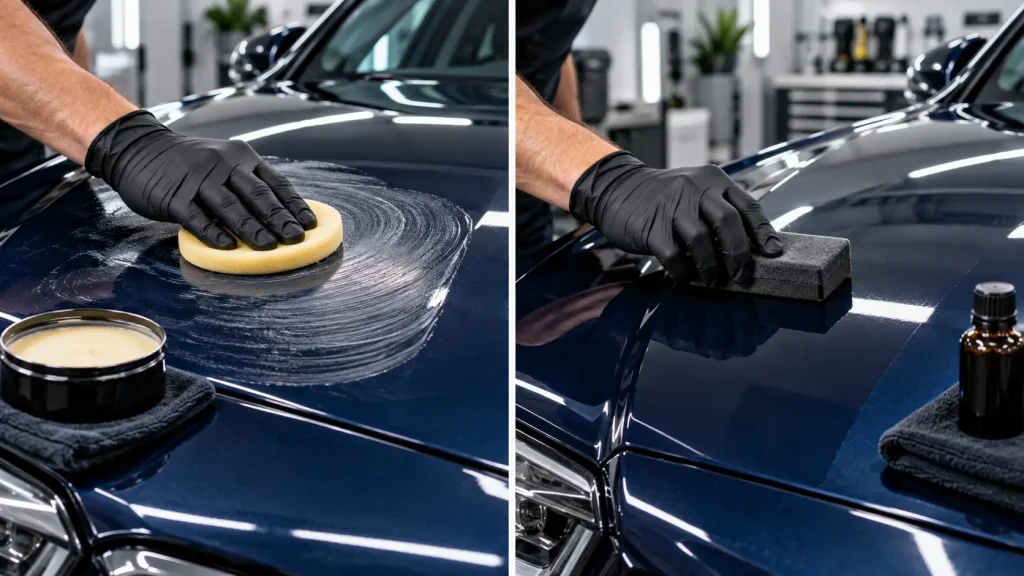
Ceramic coating offers better protection than wax for most drivers. A professional ceramic coating can last two to five years, resists heat and chemicals, and keeps brake dust from bonding to your wheels. Wax lasts only a few weeks to a few months and melts at temperatures your wheels easily reach. Wax still makes sense for low budgets and short-term shine.
If you’ve ever waxed your car on a Sunday and watched the shine fade after a few rainstorms, you already know the problem with wax. It looks great, but it doesn’t stick around. The wax vs ceramic coating debate comes down to three things: how long the protection lasts, what it can actually stop, and how much you want to spend over time.
This guide breaks it down in plain language, with extra attention to wheels, the part of your car that takes the most abuse on New York City streets.
What Is Car Wax?
Car wax is a soft protective layer that sits on top of your paint or wheel finish. Most quality waxes use carnauba, a natural wax that comes from the leaves of a Brazilian palm tree. Many products also blend in synthetic polymers or oils to make the wax easier to spread.
Wax works by filling tiny pores in the clear coat and creating a slick surface. Water beads up and rolls off. Dirt has a harder time sticking. You also get that warm, deep glow that car enthusiasts love, especially on darker colors.
The catch is that wax only rests on the surface. It doesn’t bond with the finish underneath. Heat, rain, car wash soaps, and road grime wear it away bit by bit. Most carnauba waxes give you about 4 to 12 weeks of protection, and often less if your car is parked outside all year.
What Is Ceramic Coating?
A ceramic coating is a liquid that cures into a hard, glass-like layer on your paint, wheels, or trim. Most coatings are built on silicon dioxide (SiO2), the same basic material found in quartz and glass. Some newer formulas use silicon carbide (SiC).
Unlike wax, a ceramic coating forms a chemical bond with the clear coat. Once it cures, it becomes a semi-permanent shield instead of a film that washes away. Professional-grade coatings generally last two to five years with proper care. Consumer DIY kits tend to last closer to 12 to 18 months.
Ceramic coatings are also strongly hydrophobic, which means they push water away. Water, mud, and brake dust slide off much more easily, so washing takes less time and effort.
Read More: Ceramic Coating Cost in NYC: 2026 Pricing Guide
What Does “9H Hardness” Really Mean?
You’ll see “9H” on almost every ceramic coating label. This refers to the pencil hardness test, an industry method standardized as ASTM D3363. A tester drags pencils of increasing hardness across the cured surface to see which one leaves a mark. 9H is the hardest pencil on that scale.
It does not mean the coating is as hard as a diamond, and it doesn’t mean it’s scratch-proof. It means the coating resists light marring better than bare clear coat. Be careful with brands claiming “10H” or higher. That number doesn’t exist on the standard pencil scale and is usually marketing.
Wax vs Ceramic Coating: A Side-by-Side Look
Here’s how the two compare on the points that matter most.
| Factor | Car Wax | Ceramic Coating |
|---|---|---|
| How long it lasts | About 4 to 12 weeks | About 2 to 5 years (professional) |
| How it attaches | Sits on top of the surface | Chemically bonds to the clear coat |
| Heat resistance | Low, carnauba melts around 180 to 187°F | High, stays stable far above wax |
| Chemical resistance | Weak, strips with harsh soaps | Strong against salt, bird droppings, and brake dust |
| Water beading | Good at first, fades fast | Strong and long lasting |
| Scratch resistance | Almost none | Moderate against light swirls |
| Upfront cost | Low | Higher |
| Application | Easy DIY | Best done by a trained pro |
Durability
This is where ceramic coating wins by the widest margin. You might wax a car six to eight times a year to keep it protected. A single professional ceramic coating can cover several years. Over time, that difference adds up in both cost and labor.
Heat Resistance
Heat is the biggest weakness of wax. Carnauba melts somewhere between 180 and 187°F. A dark car parked in the summer sun can come close to that range on its own. Once the oils in wax break down, it turns brittle and flakes off.
Ceramic coatings are inorganic, so they don’t soften the way wax does. They stay stable at far higher temperatures, which matters a lot for one part of your car in particular.
Chemical and UV Protection
Road salt, bird droppings, tree sap, and acidic rain all attack your finish. Wax offers a thin barrier against these, but it breaks down quickly when exposed to strong chemicals. A cured ceramic coating holds up against a much wider range of contaminants and adds solid UV protection that helps slow paint fading and oxidation.
Why Wheels Change the Wax vs Ceramic Coating Answer
Your wheels live a tougher life than any painted panel on your car. Every time you brake, the pads grind against the rotors and throw off hot metal particles called brake dust. That dust lands on your wheels, bakes onto the finish, and can slowly etch and pit the surface if you leave it there.
Now add heat. Industry sources note that wheels can run hotter than 250°F during normal driving, and brake calipers can approach 500°F. That is well above the melting point of carnauba. So when you wax your wheels, the wax softens on your first stop-and-go trip. Worse, a soft, tacky wax layer can actually trap brake dust instead of shedding it.
A ceramic coating made for wheels handles that heat without breaking down. Brake dust sits loosely on top of the slick surface instead of bonding to it. In most cases, a gentle wash with pH-neutral soap removes it. You’ll still see dust build up between washes, because no coating stops brake pads from making dust. The difference is how easily it comes off and whether it damages the finish underneath.
What This Means for New York City Drivers
City driving is hard on wheels. Constant braking in traffic means more brake dust. Winter brings road salt and de-icing chemicals that eat away at clear coats and bare aluminum. Tight parallel parking leads to curb contact. Wax simply can’t keep up with that kind of daily wear.
For drivers in the five boroughs, a ceramic coating on the wheels is one of the most practical upgrades you can make. It protects the finish you paid for and cuts down the time spent scrubbing barrels and spokes.
What Ceramic Coating Can’t Do
A good expert will tell you the limits too. A ceramic coating is strong, but it isn’t armor.
- It won’t stop rock chips or deep scratches from road debris
- It won’t prevent curb rash when a wheel scrapes a curb
- It won’t fix existing swirl marks, scratches, or oxidation on its own
- It doesn’t remove the need to wash your car regularly
If your wheels already have curb rash, peeling clear coat, or corrosion, coating over that damage just seals it in. The wheel should be repaired or refinished first so the coating bonds to a clean, smooth surface.
Cost Over Time: Which Is the Better Value?
Wax wins on upfront price. A good tin of carnauba costs little, and you can apply it yourself in an afternoon. A professional ceramic coating costs more because of the product and the prep work involved.
But it helps to look at the full picture. If you wax every six to eight weeks, you’re buying product and spending hours of labor every year. With a ceramic coating, you pay once and protection lasts for years. Washing also gets faster and easier, especially on wheels. For drivers who plan to keep their car for a few years, ceramic coating usually works out to the better value per year of protection.
Why Professional Application Matters
Ceramic coating is only as good as the surface under it. The coating bonds to whatever is on the finish, including contamination you can’t see. That’s why proper prep is the most important part of the job.
A professional process typically includes a deep wash to strip old waxes, an iron remover to dissolve embedded brake dust, and clay or decontamination to pull out bonded grime. On paint, there’s often a polishing step to remove swirls. The coating is then applied in a controlled space and left to cure.
DIY kits can work, but mistakes are hard to undo. High spots, streaks, and poor prep can leave the coating uneven or cause it to fail early. Fixing a badly applied coating often means polishing it off and starting over.
Also Read: Can Ceramic Coating Be Applied to Older Cars?
How to Maintain a Ceramic Coating
Ceramic coatings are low maintenance, not zero maintenance. A few simple habits help them last as long as possible.
Wash every one to two weeks with a pH-neutral car shampoo. Harsh, high-alkaline cleaners can wear the coating down faster. On wheels, use a soft brush and a wheel-safe cleaner rather than acid-based products. Avoid automatic car washes with stiff brushes, which can scratch even coated surfaces. Many professionals also suggest an SiO2 spray topper every few months to refresh water beading.
When Wax Still Makes Sense
Wax isn’t useless. It’s just a short-term product. Wax can be a good choice if you’re on a tight budget, if you’re selling the car soon and want a quick shine, or if you have a classic or show car that rarely sees bad weather and you enjoy the waxing process. Some enthusiasts also prefer the warm look carnauba gives to certain paint colors.
What wax shouldn’t be is your main protection for wheels or for a daily driver that faces salt, heat, and city grime.
Frequently Asked Questions
Can you put wax on top of a ceramic coating?
You can, but it’s usually not needed. Wax may actually cover the coating’s slick, water-repelling surface and lower its performance. If you want a boost, use an SiO2 spray topper made for coated cars instead.
Is ceramic coating worth it on wheels?
For most drivers, yes. Wheels face the highest heat and the most brake dust on the car. A ceramic coating resists that heat, keeps brake dust from bonding, and makes cleaning much easier. Wax melts at wheel temperatures and can’t offer the same protection.
How long does ceramic coating last on wheels?
Wheels wear coatings faster than paint because of heat and brake dust. Many wheel-specific coatings are rated for around 12 to 18 months, while some professional systems last longer. Gentle washing habits make a big difference.
Does ceramic coating prevent scratches?
It helps against light swirls and wash marring, but it won’t stop rock chips, deep scratches, or curb rash. Think of it as a tough outer layer, not a force field.
Which is better for a new car, wax or ceramic coating?
Ceramic coating is usually the better pick for a new car. The finish is fresh and clean, which means less prep work, and you lock in protection from day one.
Protect Your Wheels the Right Way With NYC Wheel Professionals
When it comes to wax vs ceramic coating, wax gives you a quick shine, while ceramic coating gives you real, lasting protection. That difference matters most on your wheels, where heat and brake dust break wax down within days.
At NYC Wheel Professionals, we work on wheels every day and know what city driving does to them. If your wheels need repair before coating or you want to protect a fresh finish, reach out to our team for an honest assessment of what your wheels need.